Technology

Language talks. Engines compute.

Deterministic computation underneath the tools your teams already use: ArcGIS, a dashboard, an API, or a plain-language ask. Language models route and narrate; engines do the math; every figure carries its receipt - by architecture, not by promise.

What it is

Architecture, not prompting.

Nexus is model-agnostic by architecture. Because the language layer only routes and narrates - it never calculates - it can run a frontier model in the cloud or an approved local model inside your walls, and not a single figure changes. Nexus will not return a figure unless it is bound to an approved engine result - named, versioned, computed against your live data, with its inputs and assumptions on the record. Anything unverifiable is refused, with the reason.
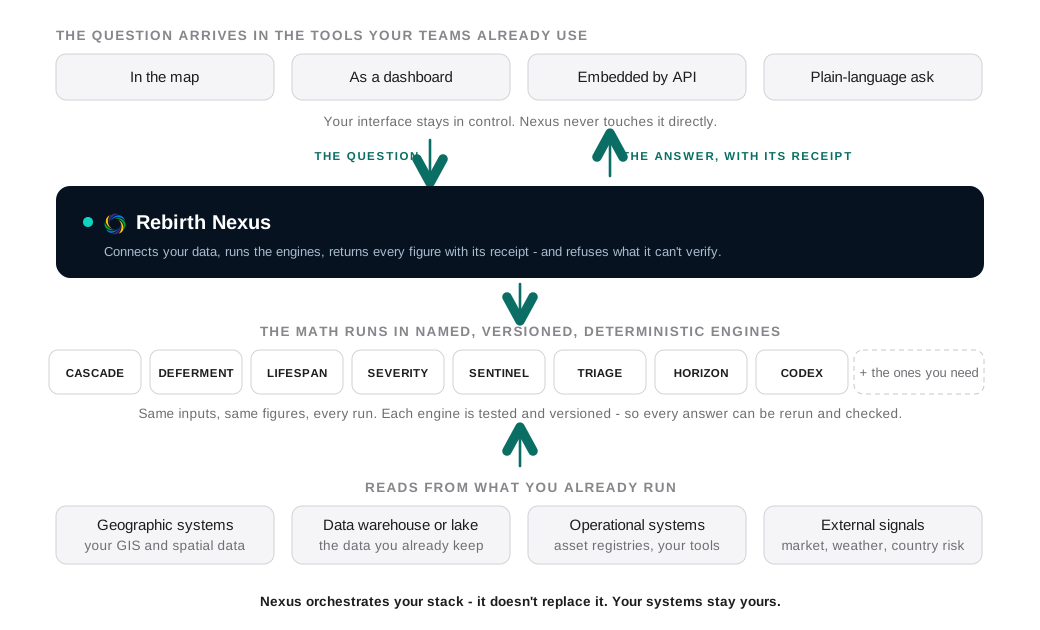
Where Nexus sits - your interfaces on top and in control, Rebirth Nexus behind them, named deterministic engines underneath, your systems at the base
Where Nexus sits: the question comes down from your interface; the answer goes back up with its receipt. Underneath: named, versioned engines, reading from the systems you already run.

Meet the engines →

The data model

Five layers, one system.

We connect everything you operate, everywhere it sits, and everyone you depend on - then model what happens next.

Operations - what you run

Your assets, flows, and commitments as a live, connected model - not a warehouse extract.

Geography - where it sits

Everything anchored to real ground through Esri ArcGIS: sites, routes, exposures, weather - on the maps your teams already run.

Signals - what's shifting around you

External conditions composed in - markets, weather, trade risk - as inputs with provenance.

Network - who you depend on

The dependency graph a consequence travels: suppliers, feeders, counterparties, routes.

Foresight - what happens next

Ranked and timed: time-to-impact on every step, early enough to move first - with uncertainty stated, not hidden.

The receipt

Don't take our word for it. Open the receipt.

Every answer Nexus returns carries a checkable record:

The engine

Which deterministic engine computed each figure - physics, statistics, economics, or engineering - and its version.

The inputs

The exact data used, its source system, and its vintage.

The assumptions

Every assumption on the record: explicit, editable, challengeable.

The rerun

Same inputs, same assumptions, same engine version: identical figures. Reproducible computation - with uncertainty stated, not hidden.

The refusal

Files that cannot be verified are refused, with the reason. A system that cannot say “no” cannot be trusted when it says “yes.”

The export

Every session exports a complete audit your own statisticians can check, line by line - every question as asked, every answer given, every figure's receipt, and every refusal with its reason. Every page signed Rebirth Nexus.

Model governance

Built for the review your regulators will run.

Versioned engines

Every engine carries a version; every answer records which one ran. Nothing changes silently.

Assumptions on record

Defaults are visible and overridable - and every override is logged with the answer it produced.

Data lineage

Each input traces to its source system and load time. Stale data is flagged, not smoothed over.

Access control

Role-based access down to the engine and dataset level - who asked what, answered from what, when.

Deployment isolation

Your cloud, your jurisdiction, or fully air-gapped. The trust stack travels with the deployment.

Human sign-off

Draft engines are born quarantined and promoted by a person - never silently into production.

Delivery

Same ease. Now with evidence.

Whichever surface your teams already love:

Inside ArcGIS

Engine answers on the map your organization already runs - painted in the visual language your reviewers already use.

The Nexus workspace

A plain-language ask, the live map, and the receipt panel - one screen for a decision.

The API

Receipted answers into your own products and workflows - the engine underneath your interface.

Why not build it yourself

You could. Here is what it takes.

The engines

Validated physics, statistics, economics, and engineering per vertical - built, tested, and receipted so a statistician can check them, line by line.

The integration

Live operational data, geography, and external signals composed into one dependency graph that stays current.

The governance

Versioning, lineage, refusal, audit export - the part procurement actually reads, built in from the first day.

The tests

Every number the system must produce is pinned by an automated test before it ships. The spec is a test suite; the warranty is that it's green.

CONTINUE THE STORY Next: Watch it workOne question, five steps, a receipt at the end. Or skip aheadBring your hardest question.