Industries · Energy

Keep the lights on - in the right order.

Electric and gas networks, transmission to distribution. When the grid fails, the question is never just what tripped. It's who goes dark, in what order, and how many minutes each backup buys.

Where the pressure sits

Three questions that keep coming back.

Cascading load

One trip re-routes load through a network that was never sized for it.

Critical customers

Hospitals, water, telecoms - criticality is a ranking, and it changes with the hour.

Restoration sequencing

The switching order that minimizes customer-minutes lost is a computation under pressure.

One question, traced

From ask to receipt.

Substation 14 trips during evening peak. Who goes dark, and in what order?

  1. Network trace - feeders, switching options, and load at risk right now
  2. Critical customers - hospitals, water, telecoms ranked by backup runtime
  3. Crew and switching plan - the restoration order that minimizes customer-minutes lost
  4. Time-to-impact - the minutes before each battery and generator runs out

RECEIPT · SIGNED, REBIRTH NEXUS · every figure above names the engine that computed it - open any step.

Illustrative scenario - not live client data.
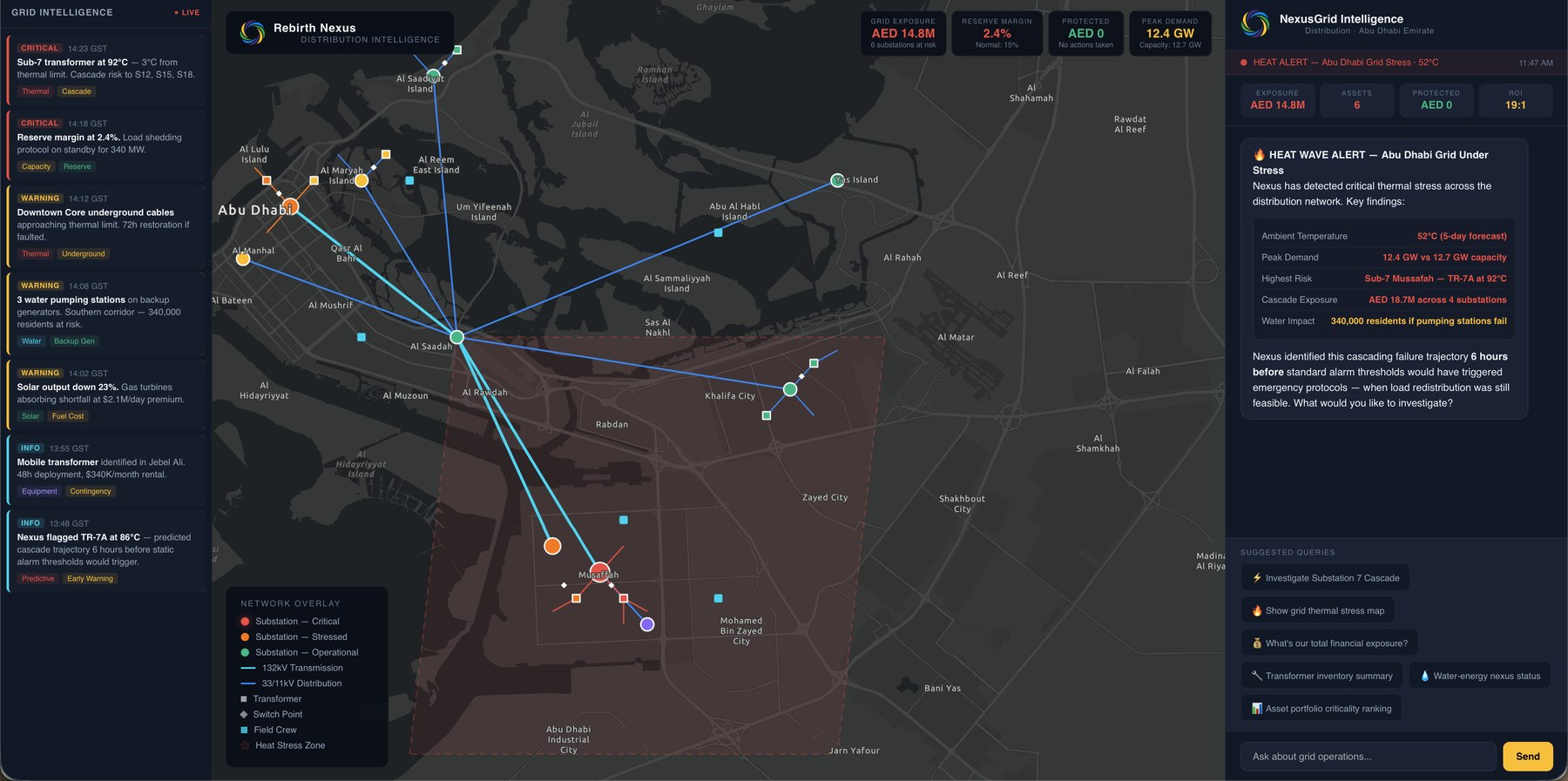
Nexus on a live grid network - synthetic demonstration
Nexus on a live grid network - synthetic demonstration.
Engine families for energy

Load flow · Criticality ranking · Restoration sequencing.

Tell us the decision you face, and a deterministic, tested, documented engine appears inside the same governed doorway - in days, not quarters.

One use case, your data, 30 days - and a receipt on everything. If seeing the full picture doesn't change the decision, you walk away.

CONTINUE THE STORY Next: Map one decision in 30 daysOne real decision, your data, a receipt on everything. Or skip aheadBring your hardest question.