Industries · Ports

See the queue before it reaches the gate.

A closed berth becomes a vessel queue, a yard problem, and a hinterland problem - on a clock the whole chain can feel.

Where the pressure sits

Three questions that keep coming back.

Vessel sequencing

Arrivals re-sequence against fewer windows, and every choice has a knock-on.

Yard pressure

Dwell and stack capacity build toward a working ceiling you can compute in advance.

Hinterland mismatch

Truck slots and rail paths stop lining up hours before anyone announces it.

One question, traced

From ask to receipt.

Berth 6 closes for emergency repair. How far does the queue reach?

  1. Vessel queue - arrivals re-sequenced against remaining berth windows
  2. Yard pressure - container dwell and stack capacity as the queue builds
  3. Hinterland effect - truck slots and rail paths that no longer line up
  4. Time-to-impact - the hours before the yard hits its working ceiling

RECEIPT · SIGNED, REBIRTH NEXUS · every figure above names the engine that computed it - open any step.

Illustrative scenario - not live client data.
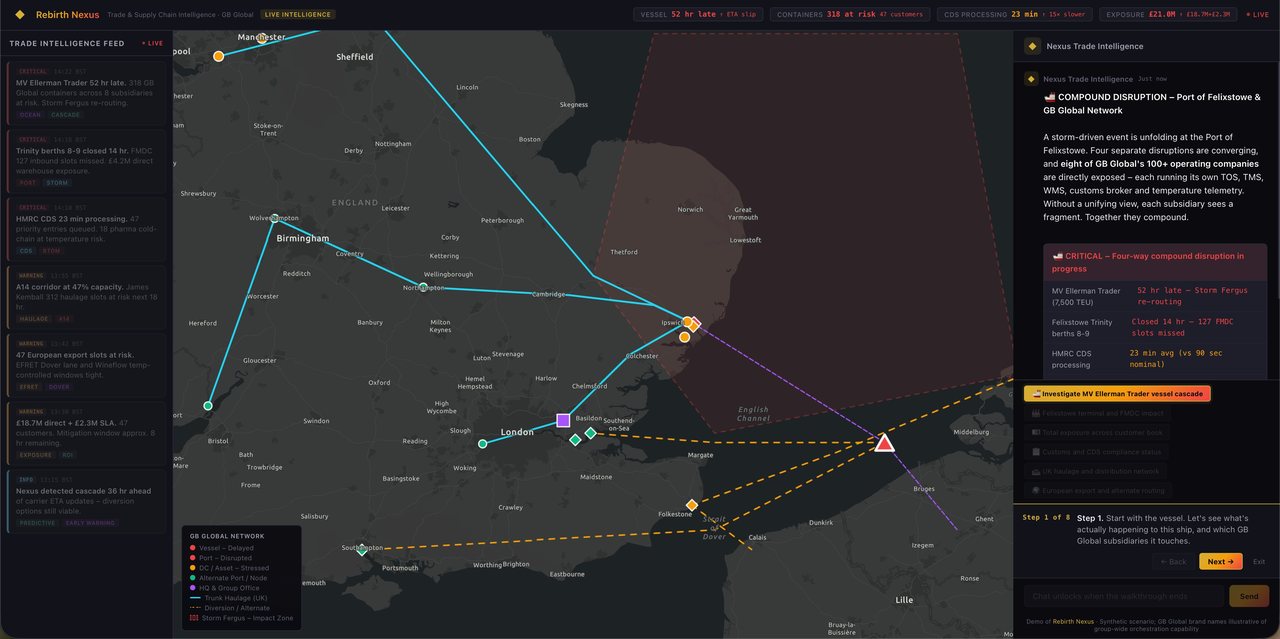
Nexus tracing port and trade flows on a live map - synthetic demonstration
Nexus tracing port and trade flows on a live map - synthetic demonstration.
Engine families for ports

Berth scheduling · Yard capacity · Hinterland flow.

Tell us the decision you face, and a deterministic, tested, documented engine appears inside the same governed doorway - in days, not quarters.

One use case, your data, 30 days - and a receipt on everything. If seeing the full picture doesn't change the decision, you walk away.

CONTINUE THE STORY Next: Map one decision in 30 daysOne real decision, your data, a receipt on everything. Or skip aheadBring your hardest question.